
October 6, 2026
Serai SD, Pepin K, Chen J, et al. Standardizing Liver MR Elastography: Guidelines for Reliable Stiffness Measurement in Chronic Liver Disease. Radiology. 2026. doi:10.1148/radiol.260974
Abstract
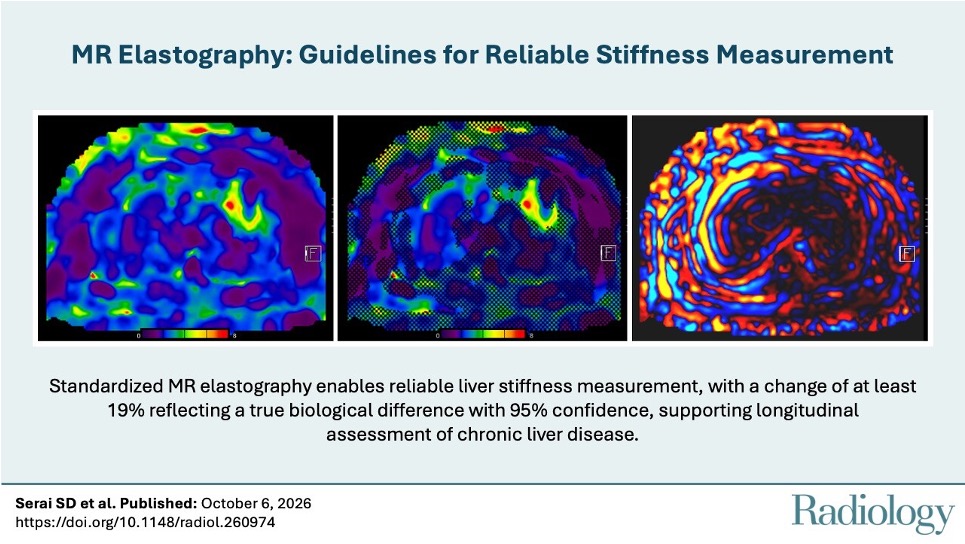
MR elastography provides the noninvasive, repeatable, and reproducible quantitative biomarker of liver stiffness for the assessment of fibrosis in chronic liver disease. However, variability in image acquisition, reconstruction, and analysis across scanners and institutions can limit measurement repeatability and reproducibility. To address this challenge, the Quantitative Imaging Biomarkers Alliance, whose work is now continued under the Quantitative Medical Imaging Coalition, developed standardized technical guidelines for liver MR elastography. These guidelines define acquisition protocols, reconstruction requirements, image quality assurance procedures, and analysis methods necessary to achieve reproducible hepatic stiffness measurements. A key quantitative claim of these guidelines is that a measured change in liver stiffness of at least 19% represents a true biologic change with 95% confidence, derived from a within-subject coefficient of variation of approximately 7%. This article describes the conceptual framework, technical specifications, and implementation considerations for standardized liver MR elastography across vendors and imaging platforms. Adoption of these guidelines supports reliable longitudinal monitoring of liver disease, facilitates multicenter clinical trials, and enables the use of liver stiffness as a validated quantitative imaging biomarker.